
The short version
- It starts in the hospital, gently. The 2026 American Heart Association and American Stroke Association guideline recommends graduated mobilization starting 24 to 48 hours after the stroke, and warns against high-dose mobilization in the first 24 hours.
- For people who qualify, inpatient rehab is the first choice. The guideline recommends an inpatient rehabilitation facility over a skilled nursing facility for them, for more functional improvement and more people going home.
- The early weeks move fastest, but later is not too late. In a classic Copenhagen study, 80 percent of patients reached their best function in daily activities within six weeks. The 2026 guideline finds that moderate- to high-intensity walking training can still help months later.
- Look past walking. Depression affects nearly one-third of people after a stroke. Swallowing, language, thinking and the weak shoulder each need attention of their own.
A stroke changes things in minutes. Rehab starts within days, while the person is still in the hospital, and before the hospital stay ends the family is usually being asked where it should continue.
This page walks through what happens next: when rehab starts, where it happens, what each therapist works on, how fast recovery tends to go, and the problems that are easy to miss. It draws on the guideline the American Heart Association and American Stroke Association published in August 2026, which replaced their 2016 version. It is general education, not advice about a particular person.
When does stroke rehab start?
In the hospital. The guideline says it plainly: “Rehabilitation should begin in the acute phase of stroke care.” The acute phase is roughly the first week.
The open question in the first days is how early is too early. The guideline recommends early mobilization, meaning getting the person sitting, standing and walking, using “a graduated mobilization protocol that commences 24 to 48 hours after stroke onset,” and says high-dose mobilization within the first 24 hours “should not be performed.”
That warning rests largely on the AVERT trial, which randomized 2,104 patients at 56 stroke units in five countries. Patients assigned to frequent, higher-dose mobilization within 24 hours were less likely to have a favorable outcome at three months than those given usual care: 46 percent against 50 percent. A favorable outcome meant being able to look after their own affairs without help. A gentle first day is consistent with the guideline: it says high-dose mobilization should not be performed in the first 24 hours, advises against using very early mobilization indiscriminately, and expects a graduated program to begin 24 to 48 hours after the stroke.
One check should come before any food, drink or pill by mouth. The guideline recommends screening for swallowing problems “as soon as possible (within 24 hours of admission)” and before the person begins eating, drinking or taking oral medications. After that come the therapy evaluations: physical, occupational and speech-language therapy each assess their own part of the picture.
Where does stroke rehab happen after the hospital?
It varies more than families expect. In one recent study of patients with traditional (fee-for-service) Medicare discharged after a stroke, which the guideline cites, 28 percent went to an inpatient rehabilitation facility, 24 percent to a skilled nursing facility and 13 percent home with home health care. The other 35 percent received no post-acute care (rehab or nursing care after the hospital stay) at all, a figure the guideline notes may be overstated because outpatient rehab was not counted.
The guideline is clear about the first choice. For people who qualify, it recommends “treatment in an IRF in preference to a SNF”, meaning an inpatient rehabilitation facility over a skilled nursing facility, for more functional improvement by discharge and higher rates of going home. That preference rests on observational studies, which compare people who went to each setting rather than assigning them at random. The guideline calls those studies “inherently limited” but finds their results consistent enough to support inpatient rehab as the preferred option for appropriate patients.
Skilled nursing is where many people go instead, including those who cannot tolerate intensive therapy or have ongoing medical needs. For people who cannot go straight home and either do not qualify for inpatient rehab or live too far from one, the guideline says skilled nursing care “can be useful” for further functional improvement. It says the same for people who finish an inpatient rehab stay but still cannot go home. For people who do go home, it recommends ongoing community- or home-based rehabilitation when feasible.
Two coverage rules shape the choice under traditional Medicare. Inpatient rehab is for people who need and can take part in an intensive program, often described as about three hours of therapy a day, although the three-hour rule is less absolute than it sounds. Skilled nursing coverage requires a three-day inpatient hospital stay first. Medicare Advantage plans must cover the same services but generally require approval in advance, called prior authorization, for inpatient rehab or skilled nursing; the guideline notes that these requirements can be a barrier to post-acute rehab, so ask the case manager early what the plan requires. The comparison page sets out the three settings side by side.
What does each therapist do after a stroke?
The guideline recommends “organized, coordinated, interprofessional care” for anyone who needs post-acute rehabilitation. In practice the work divides roughly like this, and the rehab team page covers who does what:
- Physical therapy: walking and balance. The guideline recommends task-specific training focused on overground walking, stepping, and balance: practicing walking itself, on the ground rather than on a treadmill. For people who can already walk, it does not recommend robotic gait training, or light- to moderate-intensity treadmill training, over task-specific walking practice on the ground, guided by a therapist.
- Occupational therapy: daily activities, the arm and the hand. Dressing, bathing, toileting and the tasks the person will face where they are going next. The guideline calls ADL training tailored to individual needs and eventual discharge setting useful, ADL meaning activities of daily living. For the arm, it recommends repetitive, progressively graded practice of functional tasks: real tasks, repeated often and made gradually harder.
- Speech-language pathology: speech, language, thinking and swallowing. For aphasia, meaning trouble speaking or understanding language, the guideline says a variety of speech and language treatment approaches should be administered. It adds that intensive treatment, generally five or more hours a week, can be useful.
- Nursing: skin, bladder and the rest of the day. The guideline recommends regular skin assessments in the hospital and in post-acute care to catch skin breakdown. Bladder control often improves: urinary incontinence affects 32 to 79 percent of people in the hospital after a stroke, falling to 25 percent by discharge and 16 percent at a year.
Across all of it, the guideline's message is practice. Rehabilitation “should provide sufficient amounts and intensity of various types of task practice.” After the first 24 hours, it calls for moderate- to high-intensity exercise and task practice, built up gradually as the person can tolerate it.
How long does stroke recovery take?
In the classic Copenhagen Stroke Study, 95 percent of patients were at their best in daily activities within 12.5 weeks. The 2026 guideline, though, describes rehabilitation as having no defined endpoint, and finds walking can still improve six months and beyond with moderate- to high-intensity training. The guideline divides recovery into five stages:
- Hyperacute: the first 24 hours.
- Acute: days 1 to 7.
- Early subacute: 7 days to 3 months.
- Late subacute: 3 to 6 months.
- Chronic: more than 6 months.
The classic picture of timing comes from the Copenhagen Stroke Study, which examined 1,197 patients weekly. Eighty percent reached their best function in daily activities within 6 weeks, and 95 percent within 12.5 weeks. Severity changed the pace: best function came within about 8.5 weeks after mild strokes, and within about 20 weeks after very severe ones.
That study tracked independence in basic daily activities, along with neurological recovery, and concluded that even after severe strokes, recovery should not be expected after the first five months. It did not test whether added training later could help. The 2026 guideline describes rehabilitation as “a longitudinal process with no defined endpoint,” and finds that moderate- to high-intensity walking training can improve walking speed, endurance and balance in people with subacute or chronic stroke. It notes that interventions into the chronic phase, six months and beyond, also continue to yield functional improvements in walking. It also calls periodic reassessment and re-engagement in therapy important to set new targets and prevent decline. A slowdown in one setting is a reason to reassess, not necessarily the end of recovery.

Problems that are easy to miss
Walking gets most of the attention. These get less, and each has a screen or a treatment:
- Depression and anxiety. They affect nearly one-third and one-fourth of people after a stroke, and 71 percent of cases of poststroke depression occur within the first three months. The guideline recommends screening for depression early, between 3 days and 3 months, and for depression and anxiety again at 3 and 6 months and beyond. Antidepressants can help depression, and cognitive behavioral therapy can help both. The guideline also notes that people who have had a stroke have a 73 percent greater risk of suicide attempts and suicide deaths. If the person talks about wanting to die or to harm themselves, call or text the 988 Suicide & Crisis Lifeline, or call 911 in an emergency.
- Swallowing. Beyond the first screen, the guideline says behavioral swallowing treatment is effective for improving swallowing and the range of food textures a person can manage. That means swallowing exercises and techniques taught by a speech-language pathologist.
- Language, thinking and vision. Communication disorders such as aphasia affect at least 30 percent of stroke survivors, and about half of people with an acute stroke have problems with thinking or perception (how the brain interprets what the person sees or feels). Vision problems are often silent: in the acute phase, about half of people who have one do not report symptoms, which is why the guideline recommends a hands-on vision screen rather than relying on what the person reports.
- The weak shoulder. Shoulder pain is a common result of weakness on one side; studies report it in 22 to 47 percent. The guideline recommends teaching patients and caregivers range of motion and positioning before discharge, and it recommends against overhead pulley exercises for a weak, painful or partly dislocated shoulder.
- Spasticity. Stiff, tight muscles affect about 25 to 46 percent of people after a stroke, severely in about 10 percent. Botulinum toxin injections into the affected muscles are among the treatments the guideline recommends.
- Fatigue. Exhaustion that rest does not relieve is seen in more than 40 percent of people after a stroke. Cognitive behavioral therapy can help, and the guideline does not recommend fluoxetine to treat it.
- Falls. About half of people fall at least once in the first year after a stroke. The guideline recommends a formal fall prevention program, and information for patients and caregivers on changes at home designed to reduce falls.
- Another stroke. About 1 in 10 people have another stroke within the first year, and physical inactivity is one of the highest risk factors. New stroke symptoms, such as sudden weakness or numbness, trouble speaking or a drooping face, are an emergency: call 911.
How families can help after a stroke
The guideline puts care partners inside the plan rather than beside it. It finds that engaging caregivers “as early as possible and throughout rehabilitation” can be beneficial, as can training them with teach-back, where you explain back or show the clinician what you learned, so they can check it.
If the person you care for has aphasia, ask the speech therapist about supported communication training. The guideline recommends it to build the skills of the people who talk with someone who has aphasia.
The guideline recommends a screen for each of three things that are easy to overlook: swallowing within 24 hours of admission, depression between 3 days and 3 months, and thinking and perception with a brief, validated test. Ask by name whether each has been done, and when it will be checked again. The questions page covers how to ask so you get a real answer. In a skilled nursing facility, a care plan meeting is the place to raise anything that has been missed; in the hospital or an inpatient rehab facility, ask for a family meeting with the team.
Look after yourself as well. The guideline estimates that about 2.7 million people in the United States care for someone whose main health problem is stroke, and it finds that structured support and education programs for caregivers, taken part in over time after discharge, can help with their mental health and burden.
What gets asked first
The first question families ask after a stroke is almost always about walking. The questions that change how the stay goes tend to be about what is harder to see: whether swallowing is safe, whether anyone has checked mood, and whether the person understands what the team is telling them.
That is a pattern from my own practice rather than a research finding, and so is this: each of those three is easier to raise early than to catch up on later.
Going home
The guideline calls the move from hospital to home “a highly vulnerable time”: new physical, cognitive or emotional changes, new medications and follow-up appointments, all while working out a new normal. It finds that individualized discharge planning can be useful, and discharge planning has its own page.
For people who go home, rehab continues at home or in an outpatient clinic when it can. For people at home after a mild to moderate stroke, the guideline calls telerehabilitation, meaning therapy delivered remotely, usually by video, a reasonable alternative when in-person therapy is limited or unavailable.
Driving is its own question. For anyone whose stroke left problems that could affect driving, whether with thinking, with perception or with movement, the guideline recommends “referral for an on-road test administered by an authorized person” to decide whether they are fit to drive. Rules on returning to driving vary by state.
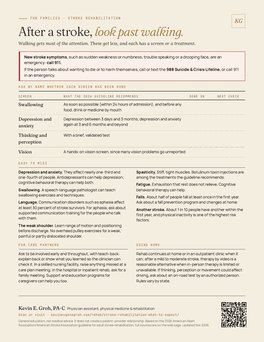
Free one-pager · PDF · 1 page
After a stroke: look past walking
The screens to ask about by name, the problems that are easy to miss, and when to call 911 or 988, on one page with space to note what has been done.
Download the PDF 261 KBSources
- Richards LG, Ifejika NL, Stein J, et al. 2026 Guideline for Adult Stroke Rehabilitation and Recovery: A Guideline From the American Heart Association and American Stroke Association. Stroke 2026;57(10):e514–e658. PMID 42657476. Timing, settings, therapies, recovery stages, complications, caregivers, discharge and driving.
- AVERT Trial Collaboration group. Efficacy and safety of very early mobilisation within 24 h of stroke onset (AVERT): a randomised controlled trial. Lancet 2015;386(9988):46–55. Retrieved via PubMed (PMID 25892679).
- Jørgensen HS, Nakayama H, Raaschou HO, et al. Outcome and time course of recovery in stroke. Part II: Time course of recovery. The Copenhagen Stroke Study. Archives of Physical Medicine and Rehabilitation 1995;76(5):406–412. Retrieved via PubMed (PMID 7741609).