
The short version
- Rehab starts on the day of surgery, or close to it. The ERAS Society's consensus on hip and knee replacement says patients should be mobilized as early as they are able. The hospital stay typically lasts 1 to 2 days, and some people go home the same day.
- Most people go home, not to a facility. In a study of hip replacements done in 2021, about 1 in 10 people who lived with others went somewhere other than home. Among people who lived alone it was more than 1 in 5, so plan help before surgery.
- Hip precautions vary, and the evidence behind them is unsettled. A 2023 review found that current evidence does not support prescribing them routinely to prevent dislocation after the posterior approach, though it rated that evidence low to very low in certainty. Follow your own surgeon's rules, and ask when they end.
- Fast at first, then months of gains. Most light daily activities return within 3 to 6 weeks. In a review of 31 studies, physical function reached about 80 percent of that of healthy people by 6 to 8 months.
Painful osteoarthritis is the main reason for a hip replacement, and rehab begins almost at once. Where it continues, and how smoothly it goes, depends a great deal on things settled before the operation: whether the surgery is same-day or overnight, what help is waiting at home, and which rules the surgeon sets for the new hip.
This page walks through it in order: when rehab starts, where it happens after the hospital, the question of hip precautions, what each therapist works on, how fast recovery tends to go, the warning signs, and what families can do. It covers planned hip replacement; rehab after knee replacement is covered separately, and a hip replaced because of a fracture is a different recovery that will get its own page. This is general education, not advice about a particular person.
When does hip replacement rehab start?
In a sense, before the operation. The Enhanced Recovery After Surgery (ERAS) Society's consensus statement on hip and knee replacement, a multidisciplinary review of the evidence, recommends education before surgery and stopping smoking at least four weeks ahead. It does not treat exercise therapy before surgery as essential: it may slightly improve early pain and function, but the consensus judged the effect on its own too small to be clinically important. If your surgeon has given you exercises to do beforehand, do them.
After the operation, getting up starts as soon as the person can manage it. The consensus says patients “should be mobilized as early as they are able”, and it calls early mobilization essential, partly to avoid the harms of prolonged bed rest, from muscle loss and reduced lung function to a higher risk of blood clots.
Some people go home the same day. Otherwise, the American Academy of Orthopaedic Surgeons (AAOS) says on its patient site that the hospital stay typically lasts 1 to 2 days, and that whether the plan is same-day or at least one night should be discussed with the surgeon before the day of the operation.
One more thing to raise early: if you have had a cortisone injection in that hip, tell the surgeon when. The timing matters more before a hip replacement than before a knee replacement, for reasons the cortisone injection page covers.
Where does hip replacement rehab happen?
For most people, at home. Before discharge, the team checks a short list of goals. The AAOS list includes getting in and out of bed alone, acceptable pain control, eating, drinking and using the bathroom, walking with an assistive device such as a walker, crutches or a cane on a level surface, managing two or three stairs, doing the home exercises, and understanding any hip precautions. The ERAS consensus recommends objective discharge criteria of the same kind, to help people go directly home.
When those goals are not yet met, or there is no one to help at home, AAOS notes that going straight home may be unsafe and a short stay in a rehabilitation or skilled nursing facility may be arranged. Living alone is strongly linked to where people go next. In a study of hip replacements done in 2021 at hospitals in the American College of Surgeons' national quality program, 22 percent of people who lived alone were discharged somewhere other than home, against 10.5 percent of similar people who lived with others.
From home, rehab usually takes one of three forms: a physical therapist visiting through a home health agency, therapy at an outpatient clinic, or a home exercise program the person does on their own. For people well enough to go straight home, the last can be enough. In a randomized trial of 120 such patients, a 10-week self-directed home exercise program and the usual plan (two weeks of home therapy visits, then eight weeks of outpatient therapy) found no significant difference in function scores at any point. The authors concluded that unsupervised home exercise is “both safe and efficacious for a majority of patients”. That does not make therapy optional for everyone. The trial enrolled people already able to go straight home, and about one in five of those assigned to home exercise ended up switching to formal therapy.
Two coverage rules shape the choice under traditional Medicare. Home health requires the person to be homebound, which is less strict than it sounds, and no hospital stay is needed. Skilled nursing generally requires a three-day inpatient hospital stay first, and same-day surgery, or a night in the hospital as an outpatient (including observation), does not count toward it. One exception applies to joint replacement: since January 1, 2026, Medicare waives the three-day rule for eligible patients with traditional Medicare whose surgery is at a hospital in a payment program called TEAM. The skilled nursing facility must have held at least a three-star Medicare rating for most of the past year. If there is any chance of needing a facility afterward, ask before surgery how the stay will be classified and whether the three-day rule will apply. Medicare Advantage plans cover the same services but generally require approval in advance, called prior authorization.
Inpatient rehabilitation facilities have a rule of their own. Each must show that at least 60 percent of its patients needed intensive rehab for one of a list of conditions set in federal regulations. On its own, a hip or knee replacement is on that list only if both hips or both knees were replaced in the same hospital stay, the person's body mass index is at least 50, or the person is 85 or older. The rule governs a facility's overall mix, not any one admission: someone who had one hip replaced can still go to inpatient rehab if they meet Medicare's criteria for it.
Do you need hip precautions?
Hip precautions are rules about positions to avoid while the tissues around the new joint heal. They have mainly been prescribed after the posterior approach, in which the surgeon reaches the joint from the back of the hip, and the usual list includes not crossing the legs, not bending at the waist beyond 90 degrees, and not turning the feet far inward or outward when bending down. AAOS notes that not all surgeons recommend the same precautions, that they vary from patient to patient with the surgical approach, and that they usually apply for about the first six weeks.
Whether everyone needs them is a live question. A 2016 Cochrane review found the evidence too weak to say whether precautions, with or without equipment and activity restrictions, prevent dislocation or improve recovery. Two newer reviews looked at the posterior approach specifically. One, covering 9,599 hip replacements, found a dislocation rate of 2.2 percent both with precautions and with minimal or no restrictions, though it rated the evidence low in quality. The other, a 2023 review of 8,835 patients, concluded that the current evidence does not support routinely prescribing precautions to prevent dislocation. It rated the certainty of the evidence low to very low and noted that better studies could change the answer. That review studied people having a hip replaced for osteoarthritis; surgeons may weigh other risks for a particular person.
None of this is a reason to drop the rules you were given. Precautions are your surgeon's call, which is part of why they differ between people and between hospitals. The practical step is to know exactly which ones apply to you, and when they end.
Falls deserve as much attention as positions. In the review of 9,599 hip replacements, falls were linked to more dislocations than any other cause, 24 percent of them. AAOS warns that a fall in the first few weeks can damage your new hip and may mean more surgery, and that the risk of dislocation is greatest in the first few months, while the tissues heal.
Weight-bearing is a separate instruction. AAOS says full weight-bearing may be allowed immediately or may be delayed by several weeks, depending on the type of hip replacement and the surgeon's instructions. The stem is the part of the implant that sits inside the thighbone. For uncemented stems, which rely on bone growing onto their surface rather than on cement, a 2010 systematic review found moderate to strong evidence that putting full weight on the leg right away does not make the stem sink or stop it bonding with the bone. That finding does not override your own instructions: a surgeon may limit weight for reasons specific to the operation.
A common question is whether the approach itself, front or back, gets someone ready to go home sooner. The ERAS consensus found “no conclusive evidence that choice of surgical approach accelerates the achievement of discharge criteria”, and made no recommendation either way.
What does each therapist do after a hip replacement?
The work divides roughly like this, and the rehab team page covers who does what:
- Physical therapy: walking, stairs and strength. Getting in and out of bed and a chair, walking with the right aid, stairs, and the exercises that rebuild strength around the hip. For uncemented hips, the 2010 review recommends starting with crutches, moving to a single cane once the person walks without a limp, and walking without crutches as soon as possible. For the first weeks, it advises taking stairs with some weight kept off the leg, because stairs put high twisting loads on the hip. AAOS says the surgeon and physical therapist help decide which aids are needed and when they can safely be put aside.
- Occupational therapy: dressing, bathing and the bathroom. Lower-body dressing, getting in and out of the shower, and using the toilet safely, often with equipment that saves bending. AAOS suggests a long-handled shoehorn, a long-handled sponge and a reacher, along with a shower chair, a grab bar and a raised toilet seat.
- Nursing: pain, clots and the wound. Pain control, wound care, and the plan to prevent blood clots, which AAOS says may include blood thinners, support stockings, inflatable leg coverings, ankle pump exercises and early walking. Medicines sent home may include pain pills, a blood thinner, a stool softener and anti-nausea medicine.
- Case management: the plan for afterward. The case manager or discharge planner arranges equipment, home health or outpatient therapy, and a facility if one is needed. AAOS notes that for people who live alone, a social worker or discharge planner can help make advance arrangements for help at home. The discharge planning page covers what has to be in place before the person leaves.
For people who do go to a skilled nursing facility, the first week in rehab has its own page.
How long does hip replacement recovery take?
Most normal light activities of daily life resume at 3 to 6 weeks, and at 6 to 8 months people rate their function at about 80 percent of healthy people’s. The pace varies from person to person. These milestones come from AAOS patient guidance and the studies cited:
- The first days: walking with a walker, crutches or cane, and home the same day or after 1 to 2 days in the hospital.
- The first weeks: some help at home for several days to several weeks, especially with cooking, shopping, bathing and laundry. Discomfort with activity and at night is common.
- Three to six weeks: most normal light daily activities, according to AAOS.
- Six to eight weeks: AAOS says most people can go back to most of the movements on the precautions list after 6 to 8 weeks, whatever the approach; your surgeon says when yours end.
- Several weeks to several months: return to work, depending on the job and the pace of recovery.
- Three to six months: mild to moderate swelling can last this long.
- Six to eight months: in the review of 31 studies, physical function as people rated it rose from less than 50 percent of that of healthy people before surgery to about 80 percent.

Driving takes more than reaction time. In a 2017 meta-analysis of 19 studies, brake reaction time was back to its pre-surgery level two weeks after a right hip replacement, though the authors say advice should be individualized. AAOS says it is usually safe to start driving again once the person is no longer taking opioid pain medication and strength and reflexes have returned, with the doctor deciding when.
Keep the exercises going after the visits end. AAOS advises continuing the prescribed exercises for at least 2 months after surgery. For sports, once the surgeon gives the go-ahead, AAOS says lower-impact activities such as swimming, golf, cycling and doubles tennis or pickleball put less stress on your hip than high-impact ones such as jogging, singles tennis and basketball.
Warning signs, and what is normal
Serious problems are uncommon: AAOS puts serious complications such as joint infection at less than 2 percent of patients. Still, a few signs need action right away:
- A possible blood clot in the leg: pain in the calf or leg that is not from the incision, tenderness or redness of the calf, or new or increasing swelling of the thigh, calf, ankle or foot. Call the surgeon right away.
- A possible clot in the lung: sudden shortness of breath, sudden chest pain, or chest pain in one spot with coughing. Clots that travel to the lungs can be life-threatening: treat these signs as an emergency and call 911.
- A possible infection: a persistent fever higher than 100°F taken by mouth, chills, increasing redness, tenderness or swelling of the wound, drainage from it, or hip pain that is increasing both with activity and at rest. Call the surgeon right away.
- A fall, or sudden severe hip pain: call the surgeon's office right away, and go to an emergency department if you cannot put weight on the leg. If the ball has come out of the socket, it usually can be put back without more surgery.
Pain that is not easing is worth a call too. AAOS advises using opioids only as directed, stopping them as soon as pain begins to improve, and talking to the doctor if pain has not begun to improve within a few days of surgery.
Some changes are usually normal, though worth mentioning at follow-up:
- Swelling. Expect it to be moderate to severe in the first few weeks. Raising the leg slightly, ice and compression stockings can help. Swelling that is new, keeps increasing, or is severe and does not go down when the leg is raised is different: it can be a sign of a clot.
- A leg that feels longer or shorter. One leg may feel longer or shorter than the other after surgery. Surgeons sometimes lengthen or shorten the leg slightly to make the hip more stable, and a shoe lift makes some people more comfortable.
- Numbness near the scar. Some numbness in the skin around the incision, and stiffness with deep bending, often lessen with time.
- Low appetite. Some loss of appetite is common for several weeks. A balanced diet and plenty of fluids help healing.
How families can help, before and after surgery
Much of the most useful work happens before surgery. AAOS suggests preparing the home in advance: remove any throw rugs, fasten electrical cords out of the way, make room to move with a walker, keep everyday things within easy reach, and, if the bedroom is upstairs, consider sleeping downstairs for a while. A firm chair with a higher seat is easier to get out of than a low, soft one.
Be there for the discharge teaching. AAOS calls it important to have a family member or other caregiver present when the instructions are reviewed. Write down the precautions, the weight-bearing instructions, the plan to prevent blood clots, and who to call, day and night. If the person lives alone, line up help before surgery: in the study above, people who lived alone were about twice as likely to be discharged somewhere other than home.
Once home, help with the graduated walking program, first indoors and later outside, make sure the exercises get done, keep the floors clear, and keep an eye out for the warning signs above.
The rules, in writing
After a hip replacement, one confusion I run into often is about precautions. The hospital teaches one version, the next therapist teaches a slightly different one, and often no one has the surgeon's own instructions on paper, or knows when they end.
I am describing what I have seen, not what a study has shown. One simple step can help: before leaving the hospital, ask for the surgeon's precautions, and when they end, in writing.
Questions to ask before surgery
Most of these have quick answers, and they are easier to settle in the surgeon's office than on the day of discharge. The questions page covers how to ask so you get a real answer.
- Is the plan same-day surgery or a hospital stay, and will the stay be inpatient or outpatient?
- Which hip precautions apply, and when do they end?
- Is full weight on the leg allowed right away?
- Will therapy be home visits, outpatient, or a self-directed program?
- What equipment should be at home before discharge, and who orders it?
- What is the plan to prevent blood clots, and for how long?
- Who is the contact for problems at night or on a weekend?
If a facility stay is possible, also ask the surgeon's office or the hospital case manager how coverage works under your plan, and read the comparison of skilled nursing, inpatient rehab and home health.
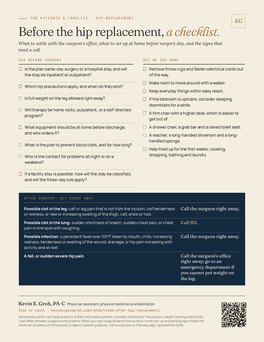
Free printable · PDF · 1 page
Before the hip replacement: a checklist
These questions, a home set-up list and the warning signs that need action, on one page to print and take to the surgeon's office.
Download the PDF 231 KBSources
- Wainwright TW, Gill M, McDonald DA, et al. Consensus statement for perioperative care in total hip replacement and total knee replacement surgery: Enhanced Recovery After Surgery (ERAS) Society recommendations. Acta Orthopaedica 2020;91(1):3–19. PMID 31663402; full text in PubMed Central. Preoperative education, smoking cessation and physiotherapy, early mobilization, criteria-based discharge, and surgical approach.
- American Academy of Orthopaedic Surgeons, OrthoInfo. Total Hip Replacement. Same-day or overnight stay, complications, blood clot prevention and warning signs, infection, falls, precautions, recovery and outcomes.
- American Academy of Orthopaedic Surgeons, OrthoInfo. Activities After Total Hip Replacement. Hospital stay, discharge goals, preparing the home, swelling, medicines, weight-bearing, driving, return to work, exercise and sports, and common precautions.
- Electronic Code of Federal Regulations. 42 CFR 412.29, Classification criteria for payment under the inpatient rehabilitation facility prospective payment system. The 60 percent compliance threshold and the joint replacement condition, paragraph (b)(2)(xiii).
- Centers for Medicare & Medicaid Services. MLN Matters MM14098: Implementing the Transforming Episode Accountability Model: Skilled Nursing Facility 3-Day Rule Waiver. Latest revision September 29, 2025; effective January 1, 2026. Who qualifies for the waiver, the skilled nursing facility star-rating requirement, and the model's 2026–2030 run.
- Agnor BK, Knio ZO, Zuo Z. Living alone predicts non-home discharge post elective hip arthroplasty: a matched-pair cohort study. PLoS One 2025;20(1):e0316024. Retrieved via PubMed (PMID 39746111). American College of Surgeons NSQIP data, 2021.
- Austin MS, Urbani BT, Fleischman AN, et al. Formal physical therapy after total hip arthroplasty is not required: a randomized controlled trial. Journal of Bone and Joint Surgery, American Volume 2017;99(8):648–655. Retrieved via PubMed (PMID 28419032).
- Hol AM, van Grinsven S, Lucas C, van Susante JLC, van Loon CJM. Partial versus unrestricted weight bearing after an uncemented femoral stem in total hip arthroplasty: recommendation of a concise rehabilitation protocol from a systematic review of the literature. Archives of Orthopaedic and Trauma Surgery 2010;130(4):547–555. Retrieved via PubMed (PMID 20012073).
- Korfitsen CB, Mikkelsen LR, Mikkelsen ML, et al. Hip precautions after posterior-approach total hip arthroplasty among patients with primary hip osteoarthritis do not influence early recovery: a systematic review and meta-analysis of randomized and non-randomized studies with 8,835 patients. Acta Orthopaedica 2023;94:141–151. Retrieved via PubMed (PMID 37039064).
- Reimert J, Lockwood KJ, Hau R, Taylor NF. Are hip movement precautions effective in preventing prosthesis dislocation post hip arthroplasty using a posterior surgical approach? A systematic review and meta-analysis. Disability and Rehabilitation 2022;44(12):2560–2566. Retrieved via PubMed (PMID 33190554).
- Smith TO, Jepson P, Beswick A, et al. Assistive devices, hip precautions, environmental modifications and training to prevent dislocation and improve function after hip arthroplasty. Cochrane Database of Systematic Reviews 2016;(7):CD010815. Retrieved via PubMed (PMID 27374001).
- van der Velden CA, Tolk JJ, Janssen RPA, Reijman M. When is it safe to resume driving after total hip and total knee arthroplasty? A meta-analysis of literature on post-operative brake reaction times. Bone & Joint Journal 2017;99-B(5):566–576. Retrieved via PubMed (PMID 28455464).
- Vissers MM, Bussmann JB, Verhaar JAN, et al. Recovery of physical functioning after total hip arthroplasty: systematic review and meta-analysis of the literature. Physical Therapy 2011;91(5):615–629. Retrieved via PubMed (PMID 21393418).