
The short version
- Exercise starts within hours. The American Academy of Orthopaedic Surgeons (AAOS) says most patients can begin exercising their knee hours after surgery. The hospital stay typically lasts 1 to 3 days, and some people go home the same day.
- Home rehab holds up well in trials. In a randomized trial of 165 people after uncomplicated knee replacement, adding 10 days of inpatient rehab to a monitored home program did not improve walking at 26 weeks. In another, unsupervised home exercise recovered knee bend as well as outpatient therapy in selected patients.
- The bend is the work. AAOS says an average of 115 degrees of motion is generally expected, and most people can bend the knee enough for stairs and cars. A knee that stays stiff can be treated, and a manipulation under anesthesia works best within 3 months of surgery.
- Most gains come early; the knee keeps settling for months. Most normal daily activities return within 3 to 6 weeks. In one study, most of the improvement in pain and function came in the first 3 months, and mild to moderate swelling can last 3 to 6 months.
Rehab after a knee replacement begins almost at once, and much of it comes down to motion. AAOS notes that restoration of full motion is uncommon and that a knee's motion after surgery can be predicted by its motion before, so the early weeks go into getting the new knee to straighten fully and bend far enough for everyday life. Where that work happens is largely decided before surgery, by whether the operation is same-day or overnight and by what help is waiting at home.
This page takes it in order: when rehab starts, where it happens after the hospital, how far the knee should bend and what happens when it will not, whether a CPM machine helps, what each therapist works on, how long recovery takes, the warning signs, and what families can do. It covers a planned total knee replacement; treatments that come before surgery, such as injections, are compared on the knee injections page. This is general education, not advice about a particular person.
When does knee replacement rehab start?
The groundwork starts before the operation. The Enhanced Recovery After Surgery (ERAS) Society's consensus on hip and knee replacement, a multidisciplinary review of the evidence, recommends preoperative patient education and quitting smoking at least four weeks ahead. Exercise beforehand is not essential in its reading of the evidence: the small early benefit did not speed the path to discharge or shorten the hospital stay. Exercises your own surgeon assigns are another matter, so do them.
After the operation, exercise starts fast: the AAOS exercise guide says the first exercises, such as ankle pumps and tightening the thigh, can begin in the recovery room. The ERAS consensus calls early mobilization essential and says patients should be mobilized as soon as possible after surgery.
Pain control shapes those first steps. For knee replacement, the consensus recommends local infiltration analgesia, numbing medicine the surgeon injects around the joint during the operation, as part of a plan that limits opioids. Nerve blocks relieve pain as well, but they can weaken the leg for a time, and the consensus notes that the femoral nerve block has been linked to more falls. If a block was used, ask whether the leg is safe to stand on before getting up without help.
Some people go home the same day; for the rest, AAOS puts the usual hospital stay at 1 to 3 days, and says the plan to be admitted or to go home should be discussed with the surgeon before the day of the operation.
One more thing to raise early: if you have had a cortisone injection in that knee, tell the surgeon when. For knees, the studies the cortisone injection page cites found no association with infection, though many surgeons still keep the gap.
Where does knee replacement rehab happen?
For most people, at home. In a national surgical quality database covering 2011 to 2016, 74 percent of people having a planned knee replacement were discharged home. Before discharge, AAOS lists goals to meet: getting in and out of bed alone, acceptable pain control, eating, drinking and using the bathroom, walking with an assistive device on a level surface and managing two or three stairs, doing the home exercises, and understanding any knee precautions. The ERAS consensus likewise recommends objective discharge criteria to help people go directly home.
When those goals are not yet met, or no one can help at home, AAOS says it may be unsafe to go straight home, and the person may be transferred for a time to a rehabilitation or skilled nursing center. For people who live alone, a social worker or discharge planner can help make advance arrangements for help at home, or for a short stay in an extended care facility.
More supervised therapy has not beaten home programs in trials. In a randomized trial in Sydney, Australia, 165 people after uncomplicated knee replacement had either 10 days of inpatient rehabilitation followed by an 8-week home program monitored by clinicians, or the home program alone. At 26 weeks there was no significant difference in a six-minute walking test, in knee pain and function scores, or in quality of life, and the authors wrote that the findings “do not support inpatient rehabilitation for this group of patients”. The trial tested people able to manage a home program; someone who cannot safely go home is a different case.
In a second randomized trial of 290 people, unsupervised home exercise, guided by a website or a printed manual, recovered knee bend as well as outpatient physical therapy, with no difference in knee scores or in time back to work, driving, or walking without an aid. Two details matter. The trial enrolled people who went home and whose knee bent at least 90 degrees before surgery, and it had a safety net: anyone on home exercise whose knee bent less than 70 degrees at 2 weeks, or less than 90 degrees at 4 weeks, was moved to outpatient therapy.
Under traditional Medicare, each setting comes with rules. Home health requires the person to be homebound, which is less strict than it sounds, but no hospital stay. A skilled nursing facility generally requires a three-day inpatient hospital stay first, and same-day surgery or nights in the hospital as an outpatient, including observation, do not count. Since January 1, 2026, a payment program called TEAM waives that rule for eligible people with traditional Medicare whose surgery is at a participating hospital, as long as the skilled nursing facility has held a Medicare rating of at least three stars for most of the past year. If a facility stay is possible, ask before surgery how your stay will be classified. Medicare Advantage plans generally require approval in advance, called prior authorization.
Inpatient rehabilitation facilities answer to a rule of their own: each must show that at least 60 percent of its patients needed intensive rehab for one of a list of conditions in federal regulations. A knee replacement is on that list only if both knees were replaced during the same hospital stay, the person's body mass index is at least 50, or the person is 85 or older. The rule shapes a facility's overall mix, not a single admission, so someone with one new knee can still be admitted when they meet Medicare's criteria for it.
How much should the knee bend after a knee replacement?
Enough for stairs, chairs and cars, and close to fully straight. AAOS puts the motion generally expected after surgery at an average of 115 degrees, and says most people can almost fully straighten the replaced knee and bend it enough to climb stairs and get in and out of a car. Full motion is uncommon, and motion before surgery predicts much of the motion after, so a knee that was very stiff beforehand may not reach the average.
Straightening deserves as much attention as bending, and the AAOS guide includes a knee straightening exercise: a small rolled towel just above the heel, so the heel does not touch the bed, while the thigh muscle tightens to press the back of the knee down.
There is no single schedule, but the home-exercise trial above gives a sense of the early pace. Its home groups switched to outpatient therapy if the knee bent less than 70 degrees at 2 weeks or 90 degrees at 4 weeks. Those were the trial's thresholds, not a rule for everyone. If your knee is behind them, ask the surgeon or therapist where they expect it to be.
In a small number of people the knee becomes stiff and painful. AAOS says this normally gets better with physical therapy and range-of-motion exercises. When it does not, the surgeon may recommend a manipulation under anesthesia: with the person asleep, the surgeon bends and straightens the knee to break up scar tissue. There is no incision, and people usually go home the same day.
Timing matters. AAOS calls within 3 months after surgery the ideal time, and a surgeon worried about stiffness may check the knee's motion just before that mark. In a 2024 meta-analysis of 14 studies covering 13,445 knees, most of which counted manipulation within 3 months as early, both groups ended with similar bend; the early group started lower and gained more, 32 degrees against 19. Later manipulation came with more complications and more revision surgery. The studies were not randomized. AAOS adds that the best way to avoid a manipulation is doing the exercises as instructed.
Do you need a CPM machine after a knee replacement?
Usually not. A continuous passive motion, or CPM, machine slowly bends and straightens the knee while the person lies still. A Cochrane review of 24 randomized trials with 1,445 participants found that adding CPM to usual care improved active knee bend by about 2 degrees, and concluded that CPM “does not have clinically important effects” on knee bend, pain, function or quality of life to justify routine use.
It may lower the chance of needing a manipulation, but the evidence for that is of very low quality. Some surgeons still use CPM, for example after a manipulation, though AAOS notes that not every doctor prescribes it for every patient. If one is prescribed, use it as directed: in the trials it was added to usual care, not used in place of it.
What does each therapist do after a knee replacement?
Roughly, the work splits like this; the rehab team page explains each role in more detail:
- Physical therapy: motion, walking and stairs. The exercises that straighten and bend the knee and strengthen the thigh, walking with the right aid, and stairs. AAOS says the surgeon and therapist may recommend exercising 20 to 30 minutes a day, or even two or three times a day, and walking for 30 minutes two or three times a day early on. Most people move from a walker or crutches to a single crutch or cane once they can walk and stand for more than 10 minutes without leaning on the aid, often about 2 to 3 weeks after surgery, holding it in the hand opposite the new knee. On stairs, the rule is “up with the good” and down with the operated knee, using a handrail.
- Occupational therapy: dressing, bathing and the bathroom. Lower-body dressing, showering and using the toilet safely, with equipment that saves bending. AAOS lists a long-handled shoehorn, a long-handled sponge and a reaching tool, and in the bathroom a shower chair, a grab bar and a raised toilet seat.
- Nursing: pain, swelling, clots and the wound. Pain control, ice and elevation for swelling, wound care, and the plan to prevent blood clots, which AAOS says may include blood thinners, support stockings and compression boots, along with foot and ankle movement. Medicines sent home may include opioid and non-opioid pain pills, a blood thinner, a stool softener and anti-nausea medicine.
- Case management: the plan for afterward. The case manager or discharge planner arranges equipment, home health or outpatient therapy, and a facility if one is needed. The discharge planning page covers what has to be in place before the person leaves.
For people who do go to a skilled nursing facility, the first week in rehab has its own page.
How long does knee replacement recovery take?
Most normal daily activities return within 3 to 6 weeks, most of the gain in pain and function comes in the first 3 months, and a full recovery takes several months. The pace varies from person to person. These milestones come from AAOS patient guidance and the studies cited:
- The first days: walking with a walker or crutches, and home the same day or after 1 to 3 days in the hospital.
- The first weeks: help at home for several days to several weeks. Some pain with activity and at night is common for several weeks.
- About two to three weeks: often, a single crutch or cane in place of the walker or crutches.
- Three to six weeks: most normal activities of daily living, according to AAOS.
- Four to six weeks: most people resume driving, and light ankle weights for resistance exercises usually can begin.
- By three months: in a study that followed 84 people after knee replacement, most improvement in pain and function came in the first 3 months, with no significant change between 3 and 12 months. This is also the window in which a stiff knee is best treated.
- Three to six months: mild to moderate swelling can last this long.
- Several months: AAOS says a full recovery will take several months.

Driving takes more than a bent knee. In a 2017 meta-analysis of 19 studies, brake reaction time was back to its pre-surgery level four weeks after a right knee replacement, though the authors say advice should be individualized. AAOS says driving is usually safe once the person is no longer taking opioid pain medication and strength and reflexes have returned, and once the knee bends enough to sit comfortably in the car; the doctor helps decide when.
Keep the exercises going after the visits end. AAOS advises continuing them for at least 2 months after surgery, and a stationary bike can help keep the knee flexible. Once the surgeon allows it, swimming can start when the wound has healed, and lower-impact activities such as golf, cycling and pickleball are preferable to high-impact ones such as jumping, jogging and skiing. When to go back to work depends on the job and on the speed of your recovery.
Warning signs, and what is normal
Serious complications, such as an infection of the knee joint, occur in fewer than 2 percent of patients, according to AAOS. A few signs still need action right away:
- A possible blood clot in the leg: increasing pain in the calf, tenderness or redness above or below the knee, or new or increasing swelling in the calf, ankle and foot. Call the surgeon right away.
- A possible clot in the lung: sudden shortness of breath, sudden chest pain, or chest pain in one spot with coughing. A clot that travels to the lungs can be life-threatening: treat these signs as an emergency and call 911.
- A possible infection: a persistent fever higher than 100°F taken by mouth, chills, increasing redness, tenderness or swelling of the knee wound, drainage from it, or knee pain increasing with both activity and rest. Call the surgeon right away.
- A fall: AAOS warns that a fall in the first few weeks can damage your new knee and may lead to more surgery. Call the surgeon's office right away, and go to an emergency department if you cannot put weight on the leg.
Pain that is not easing deserves a call too. AAOS advises talking to the doctor if pain has not begun to improve within a few days of surgery, and stopping opioids as soon as the pain begins to improve.
Some changes are usually normal, though worth mentioning at follow-up:
- Swelling. Moderate to severe swelling is common in the first few days or weeks, and raising the leg, ice and compression stockings can help. Swelling that is new, or keeps increasing in the calf, ankle or foot, is different: it can be a sign of a clot.
- Clicking. Most people feel or hear some clicking of the metal and plastic when bending or walking. AAOS calls it normal, and it often lessens with time.
- Numbness near the scar. Most people have some numbness in the skin around the incision, and some stiffness with deep bending.
- Trouble kneeling. AAOS says kneeling is sometimes uncomfortable, but it is not harmful. Many people still cannot: in a review of 36 studies, about 37 percent of people could kneel at a year or more after surgery, and about 48 percent at three years or more.
Expectations matter, because a knee replacement does not relieve everyone's pain. A systematic review of studies that followed unselected patients for between 3 months and 5 years found that about 20 percent of people in the best studies had moderate to severe pain, or pain the operation had not relieved, after a knee replacement, against 9 percent or more after a hip replacement. AAOS calls continued pain rare; this review also counted moderate pain. In a study of 1,703 knee replacements in Ontario, about 1 in 5 people were not satisfied with the result, and unmet expectations were the strongest predictor of dissatisfaction. Pain that lingers or comes back months later deserves a visit to the surgeon, since stiffness and infection are among the causes that can be treated.
How families can help after a knee replacement
Much of the useful work happens before surgery. AAOS suggests rearranging furniture to make room for a walker or crutches, moving the bedroom downstairs for a while if stairs are hard, setting up a “recovery center” with everyday things within easy reach, removing throw rugs and fastening electrical cords out of the way. It also suggests a firm chair with a higher-than-average seat and a footstool for raising the leg, and secure handrails along the stairs.
Line up help before the operation: AAOS advises arranging for a friend, family member, or caregiver to help at home after discharge. Be there for the discharge teaching if you can, and write down the exercises, any knee precautions, the plan to prevent blood clots, and who to call, day and night.
Once home, help with ice and elevation after exercise. AAOS suggests ice on the knee for 20 minutes on and 20 minutes off, repeated for about 2 hours, with the leg raised. Keep the walking program going, make sure the exercises get done, and watch for the warning signs above.
Write down the numbers
At each therapy visit, ask for two numbers: how far the knee bends, and how close it comes to straight, both in degrees. Written down week by week, they show whether the knee is on track long before anyone uses the word stiffness.
A knee that has stopped gaining is worth raising early, while exercise and, if it comes to that, a manipulation can still do the most good.
Questions to ask before a knee replacement
Most of these have quick answers, and they are easier to settle in the surgeon's office than on the day of discharge. The questions page covers how to ask so you get a real answer.
- Is the plan same-day surgery or a hospital stay, and will the stay be inpatient or outpatient?
- Will a nerve block be used for pain, and how long might the leg be weak afterward?
- How far should the knee bend at 2, 4 and 6 weeks, and when should I call if it is behind?
- Will therapy be home visits, outpatient, or a home program, and is a CPM machine part of the plan?
- Are there any knee precautions, or limits on putting weight on the leg?
- What equipment should be at home before discharge, and who orders it?
- What is the plan to prevent blood clots, and for how long?
- Who is the contact for problems at night or on a weekend?
If a facility stay is possible, also ask the surgeon's office or the hospital case manager how coverage works under your plan, and read the comparison of skilled nursing, inpatient rehab and home health.
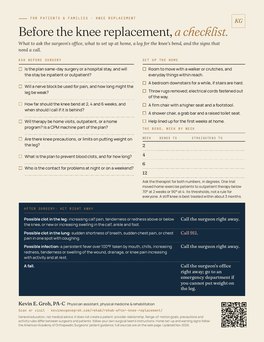
Free printable · PDF · 1 page
Before the knee replacement: a checklist
The key questions, a home set-up list, a log for the knee's bend week by week, and the warning signs that need action, on one page to print and take to the surgeon's office.
Download the PDF 260 KBSources
- Wainwright TW, Gill M, McDonald DA, et al. Consensus statement for perioperative care in total hip replacement and total knee replacement surgery: Enhanced Recovery After Surgery (ERAS) Society recommendations. Acta Orthopaedica 2020;91(1):3–19. PMID 31663402; full text in PubMed Central. Preoperative education, smoking cessation and physiotherapy, local infiltration analgesia and nerve blocks in knee replacement, early mobilization, and criteria-based discharge.
- American Academy of Orthopaedic Surgeons, OrthoInfo. Total Knee Replacement. Same-day or overnight stay, exercise after surgery, help at home, blood clot prevention and warning signs, infection, falls, expected motion, driving, and how a new knee feels.
- American Academy of Orthopaedic Surgeons, OrthoInfo. Activities After Total Knee Replacement. Hospital stay, discharge goals, preparing the home, swelling, medicines, driving, return to work, and exercise and sports.
- American Academy of Orthopaedic Surgeons, OrthoInfo. Total Knee Replacement Exercise Guide. Early exercises, knee straightening, walking aids, stairs, resistance exercise, the exercise bike, and ice.
- American Academy of Orthopaedic Surgeons, OrthoInfo. Manipulation Under Anesthesia After Total Knee Replacement. Stiffness, the procedure, timing, and continuous passive motion afterward.
- Electronic Code of Federal Regulations. 42 CFR 412.29, Classification criteria for payment under the inpatient rehabilitation facility prospective payment system. The 60 percent compliance threshold and the joint replacement condition, paragraph (b)(2)(xiii).
- Centers for Medicare & Medicaid Services. MLN Matters MM14098: Implementing the Transforming Episode Accountability Model: Skilled Nursing Facility 3-Day Rule Waiver. Latest revision September 29, 2025; effective January 1, 2026. Who qualifies for the waiver and the skilled nursing facility star-rating requirement.
- Akhtar M, Razick D, Seibel A, et al. Outcomes of early versus delayed manipulation under anesthesia for stiffness following total knee arthroplasty: a systematic review and meta-analysis. Journal of Arthroplasty 2024;39(11):2872–2879. Retrieved via PubMed (PMID 38797451).
- Beswick AD, Wylde V, Gooberman-Hill R, Blom A, Dieppe P. What proportion of patients report long-term pain after total hip or knee replacement for osteoarthritis? A systematic review of prospective studies in unselected patients. BMJ Open 2012;2(1):e000435. Retrieved via PubMed (PMID 22357571).
- Bourne RB, Chesworth BM, Davis AM, Mahomed NN, Charron KDJ. Patient satisfaction after total knee arthroplasty: who is satisfied and who is not? Clinical Orthopaedics and Related Research 2010;468(1):57–63. Retrieved via PubMed (PMID 19844772).
- Buhagiar MA, Naylor JM, Harris IA, et al. Effect of inpatient rehabilitation vs a monitored home-based program on mobility in patients with total knee arthroplasty: the HIHO randomized clinical trial. JAMA 2017;317(10):1037–1046. Retrieved via PubMed (PMID 28291891).
- Fleischman AN, Crizer MP, Tarabichi M, et al. 2018 John N. Insall Award: recovery of knee flexion with unsupervised home exercise is not inferior to outpatient physical therapy after TKA: a randomized trial. Clinical Orthopaedics and Related Research 2019;477(1):60–69. Retrieved via PubMed (PMID 30794229).
- Harvey LA, Brosseau L, Herbert RD. Continuous passive motion following total knee arthroplasty in people with arthritis. Cochrane Database of Systematic Reviews 2014;(2):CD004260. Retrieved via PubMed (PMID 24500904).
- Lenguerrand E, Wylde V, Gooberman-Hill R, et al. Trajectories of pain and function after primary hip and knee arthroplasty: the ADAPT cohort study. PLoS One 2016;11(2):e0149306. Retrieved via PubMed (PMID 26871909).
- Nadeem S, Mundi R, Chaudhry H. Surgery-related predictors of kneeling ability following total knee arthroplasty: a systematic review and meta-analysis. Knee Surgery & Related Research 2021;33(1):36. Retrieved via PubMed (PMID 34600595).
- Sodhi N, Anis HK, Coste M, et al. A nationwide analysis of preoperative planning on operative times and postoperative complications in total knee arthroplasty. Journal of Knee Surgery 2019;32(11):1040–1045. Retrieved via PubMed (PMID 30786290). American College of Surgeons NSQIP data, 2011–2016.
- van der Velden CA, Tolk JJ, Janssen RPA, Reijman M. When is it safe to resume driving after total hip and total knee arthroplasty? A meta-analysis of literature on post-operative brake reaction times. Bone & Joint Journal 2017;99-B(5):566–576. Retrieved via PubMed (PMID 28455464).