
The short version
- Walking starts on the day of surgery. In a Michigan registry of 23,295 lower-back surgery patients, walking that day went with shorter hospital stays, fewer readmissions and fewer urinary problems. A later study of neck and back surgery found fewer complications with walking within 8 hours. Neither was a randomized trial.
- Braces and collars often add little. In a 2024 meta-analysis of five randomized trials, a brace after a lower-back fusion for wear-and-tear (degenerative) conditions made no substantial difference in pain, function or healing, and a randomized trial found no advantage to a collar after a one- or two-level fusion through the front of the neck. If your surgeon prescribes one, wear it as directed.
- Formal therapy has its best evidence a few weeks out. On low-quality evidence, exercise programs starting 4 to 6 weeks after disc surgery eased pain and disability faster than no treatment, at least in the short term. After a fusion, the American Academy of Orthopaedic Surgeons (AAOS) says physical therapy typically starts 6 weeks to 3 months after surgery.
- A fusion takes months to heal. MedlinePlus says bone takes at least 3 to 4 months to heal well, and healing may continue for at least a year. In one study, a fusion failed to heal in 26.5 percent of people who kept smoking, against 14.2 percent of nonsmokers.
Spine surgery is several different operations, and recovery depends on which one. A discectomy removes the part of a disc pressing on a nerve, and MedlinePlus calls recovery afterward “usually quick”: pain, numbness or weakness along the nerve should get better in a few weeks. A decompression, or laminectomy, makes more room around the nerves, and a fusion joins two or more vertebrae so they heal into a single, solid bone. Recovery after a laminectomy or a fusion is longer, and a fusion is not finished until the bone has healed.
This page takes it in order: when rehab starts, where it happens after the hospital, back precautions, braces and collars, what each therapist works on, how long recovery takes, the warning signs, and what families can do. It covers planned surgery on the lower back and the neck, mainly a discectomy, a decompression or a fusion. Recovery after a spinal cord injury or a broken vertebra is a different path. This is general education, not advice about a particular person.
When does rehab start after spine surgery?
Before the operation, with education and a plan for pain. The Enhanced Recovery After Surgery (ERAS) Society's 2021 consensus on lumbar fusion, a review of the evidence by an international group, makes recommendations that run from preoperative patient education and a check of nutrition to pain control afterward that combines several kinds of medicine. Exercise before surgery did not make its final list, because of very poor quality and conflicting evidence in lumbar fusion.
For a fusion, quitting smoking matters. In a review of 357 people after a lower-back fusion, the bone failed to fuse in 26.5 percent of those who kept smoking, against 14.2 percent of nonsmokers, and in 17.1 percent of those who quit for more than 6 months after surgery. AAOS likewise says that people who smoke are more likely to develop a pseudarthrosis, a fusion that does not become solid. Ask the surgeon when to stop and what help is available.
After the operation, walking comes first, often within hours. Early walking is considered a key element of enhanced recovery programs after spine surgery. The Michigan Spine Surgery Improvement Collaborative, a registry of spine surgery patients, followed 23,295 people after lower-back surgery. Those who walked on the day of surgery had shorter hospital stays, fewer readmissions, and less urinary retention, urinary infection and ileus, a bowel that stops moving for a time. They were also less likely to be discharged to a rehab facility. Rates of wound infection and blood clots did not differ.
A later study from the same registry, covering 7,647 neck and 17,616 lower-back operations, found more complications when the first walk came later than 8 hours after surgery. Both were registry studies, not trials, so people who walked early may also have been healthier to begin with. Still, the authors called walking on the day of surgery a modifiable factor that should be encouraged.
AAOS says that right after the operation, the doctor may recommend only light activity, like walking, building up as strength returns, and that people are taught how to move, reposition, sit, stand and walk while the fusion heals. MedlinePlus advises only short walks for the first 2 weeks, then slowly walking farther.
Where does rehab happen after spine surgery?
That depends on the operation and on the person, and after a fusion, many people need help when they leave the hospital. In a study of 261,558 people with Medicare who had a lower-back fusion from 2012 to 2014, 50.8 percent were discharged to rehabilitation-based care: an inpatient rehabilitation facility, a skilled nursing facility, a long-term care hospital, or home health. Those people were older, had more health conditions and had stayed longer in the hospital.
When someone cannot yet manage safely at home, or no one can help there, a short stay in a facility or home health visits may come first. The discharge planning page covers what has to be in place before the person leaves.
Under traditional Medicare, each setting comes with rules. Home health requires the person to be homebound, which is less strict than it sounds, but no hospital stay. A skilled nursing facility generally requires a three-day inpatient hospital stay first, and same-day surgery or nights in the hospital as an outpatient, including observation, do not count. Since January 1, 2026, a payment program called TEAM waives that rule for eligible people with traditional Medicare after a spinal fusion, one of the five operations in the program, at a participating hospital, as long as the skilled nursing facility has held a Medicare rating of at least three stars for most of the past year. A discectomy or a decompression without a fusion is not one of the five, so TEAM's waiver does not cover it. If a facility stay is possible, ask before surgery how your stay will be classified. Medicare Advantage plans generally require approval in advance, called prior authorization.
Inpatient rehabilitation facilities answer to a rule of their own: each must show that at least 60 percent of its patients needed intensive rehab for one of a list of conditions in federal regulations. Spinal cord injury is on that list; a routine back or neck operation is not. The rule shapes a facility's overall mix, not a single admission, so someone can still be admitted after spine surgery when they meet Medicare's criteria for it.
Do you need back precautions after spine surgery?
Usually, for a while, and the surgeon sets them. Many surgeons limit bending, lifting and twisting at first. After a discectomy, AAOS says people may be prohibited from bending, lifting, and twisting for the first few weeks, to lower the risk of the disc herniating again. MedlinePlus advises not lifting anything heavier than about 10 pounds, about a gallon of milk, and trying not to sit for longer than 20 or 30 minutes at a time.
The evidence for strict limits is thin, at least after a discectomy. In a study of 152 working people who were given no activity restrictions after a limited discectomy and encouraged to return to full activity as soon as possible, the average time off work was 1.2 weeks, and returning early was not linked to recurrent sciatica or reoperation. About 1 in 9 had possible recurrent sciatica and about 5 percent needed another operation, rates the authors judged comparable to those reported for people with restrictions. The study had no comparison group of its own. A Cochrane review of rehabilitation after disc surgery adds that none of the trials reported more reoperations with exercise.
A fusion is different, because the bone has to heal. AAOS lists moving too soon, before the bone is able to start fusing, among the causes of a fusion that does not become solid. Ask the surgeon which precautions apply, and when each one ends.
Do you need a brace or a neck collar after spine surgery?
Often not, by the evidence. Surgeons still prescribe them; for lower-back braces, the decision is based primarily on clinical experience rather than strong evidence. A 2024 meta-analysis of five randomized trials with 362 patients found that bracing after a fusion in the lower back, done for degenerative conditions, made no substantial difference in pain relief, recovery of function, complications or fusion rates. In one of the earlier trials, people who wore a corset full time for eight weeks after the same kind of fusion did no better at two years than those who went without.
The neck shows the same pattern. In a randomized trial of 50 people after a one- or two-level anterior cervical discectomy and fusion (ACDF), a fusion done through the front of the neck, the researchers found no advantage to wearing a collar for 6 weeks, in disability scores or in fusion at one year. In data from a 32-center trial of 257 people after a single-level fusion with a plate, those who wore a collar did no better than those who did not, though the collar itself was not randomly assigned.
A brace may still make sense for a particular spine, and AAOS notes that your surgeon may suggest that you wear a brace to help protect the healing fusion. If one is prescribed, MedlinePlus says to wear it when you are sitting or walking and as the surgeon instructs. Ask when it can come off.
What does each therapist do after spine surgery?
Roughly, the work splits like this; the rehab team page explains each role in more detail:
- Physical therapy: walking, moving safely, and later strength. Early on, getting in and out of bed, sitting, standing, walking and stairs in ways that respect the precautions. Formal exercise often comes later. A Cochrane review of 22 trials after disc surgery found that programs starting right after surgery were not more effective than the comparison treatments, which included exercise, while programs starting 4 to 6 weeks after surgery eased pain and disability faster than no treatment in the short term, on low-quality evidence, with no clear difference between supervised and home programs. After surgery for spinal stenosis, another Cochrane review found that active rehab modestly improved function in the short term and at a year compared with usual care. After a fusion, AAOS says the surgeon will talk to you about whether you need physical therapy; a review found low-quality evidence that rehab combining exercise with cognitive behavioral therapy, which works on fear of movement, reduced disability more than usual care.
- Occupational therapy: dressing, bathing and the bathroom. Getting dressed, showering and using the toilet without breaking the precautions, often with equipment that saves bending and twisting.
- Speech-language pathology: swallowing and voice, after neck surgery. After surgery through the front of the neck, trouble swallowing is common. In a study that followed 249 people, about half reported it at 1 month, 32 percent at 2 months, 18 percent at 6 months and 12.5 percent at a year, and only 4.8 percent had moderate or severe trouble at 6 months. A speech-language pathologist can check swallowing and suggest safer ways to eat and drink.
- Nursing: pain, the wound, the bladder and bowels, and clots. Pain control, wound care, watching for trouble passing urine and for constipation, and the plan to prevent blood clots. AAOS warns that clots can form in the legs and are dangerous if they travel to the lungs.
- Case management: the plan for afterward. The case manager or discharge planner arranges equipment, home health or outpatient therapy, and a facility if one is needed.
For people who do go to a skilled nursing facility, the first week in rehab has its own page.
How long does spine surgery recovery take?
Weeks after a discectomy, and months after a fusion, because the bone has to heal. AAOS says it may be several months before the bone is solid, although comfort often improves much sooner. The pace also depends on the person and on how bad the condition was before surgery. These milestones come from the sources cited:
- The day of surgery: walking, often within hours. In the later registry study, walking within 8 hours was linked to fewer complications.
- The first 2 weeks: short walks, stairs once a day if they do not cause much pain, and no driving. After 2 weeks, MedlinePlus says short trips are fine only if your surgeon says it's OK.
- A few weeks: after a discectomy, pain, numbness or weakness along the nerve should get better. AAOS says pain usually improves first, followed by overall leg strength, and, finally, sensation.
- One to eight weeks: in the study of people with no restrictions after a discectomy, about a third were back at work within a week, and 148 of the 149 who returned were on full duty by 8 weeks.
- Four to six weeks: when 16 of the 22 trials in the Cochrane review of disc surgery started their programs. After a fusion, MedlinePlus says someone young and healthy, whose job is not very strenuous, will probably be off work for 4 to 6 weeks.
- Six weeks to three months: after a fusion, AAOS says physical therapy typically starts in this window.
- Three to four months: the least time bone takes to heal well after a fusion, according to MedlinePlus.
- Four to six months: older people after more extensive surgery may take up to this long to get back to work, according to MedlinePlus.
- A year or more: fusion healing may continue for at least a year.

Keep walking after formal therapy ends. After a discectomy, AAOS says a doctor or physical therapist may recommend a simple walking program, such as 30 minutes each day, along with specific exercises. MedlinePlus says to hold off on swimming, golf, running and other more strenuous activities until you see your surgeon.
Warning signs after spine surgery, and what is normal
A few signs need action right away:
- Bladder or bowel trouble, or numbness between the legs: being unable to urinate, leaking urine, losing bowel control, or new numbness between the legs, over the buttocks or in the inner thighs. These can be signs of cauda equina syndrome, pressure on the nerve roots at the bottom of the spine, which AAOS calls a surgical emergency. Go to an emergency department.
- New or worsening weakness or numbness: in the legs or feet after back surgery. After neck surgery, in the arms or hands, or in the legs: pressure on the spinal cord in the neck can show up as trouble walking, loss of balance, or weakness in the legs. MedlinePlus lists a change of feeling in the arms after neck surgery, or in the legs and feet after back surgery, among the reasons to call. Call the surgeon right away, and go to an emergency department if the weakness is severe or getting worse fast.
- After neck surgery, trouble breathing or a swelling neck: bleeding after surgery through the front of the neck is rare, about 4 in 1,000 operations in one hospital's 13,523 cases, but bleeding or swelling there can press on the airway. In an older series, airway problems appeared on average 36 hours after surgery, so the risk does not end in the recovery room. Trouble breathing, or neck swelling that is getting worse, means calling 911. Swallowing that is getting worse rather than better deserves a call to the surgeon the same day.
- A possible blood clot in the leg: swelling in the calf, ankle, or foot, tenderness or redness, or pain in the calf. Call the surgeon right away.
- A possible clot in the lung: sudden chest pain and shortness of breath or coughing, which AAOS says can mean a clot has traveled to the lungs. Call 911 rather than waiting to reach the surgeon.
- A possible infection: AAOS says infection after spine surgery occurs very rarely, but call the surgeon right away for increasing redness, tenderness or swelling around the wound, drainage, shaking chills, or a fever of 101°F (38.3°C), or higher.
- Pain that is getting worse: MedlinePlus lists more pain where you had your surgery, and back pain that worsens and does not get better with rest and pain medicine, among the reasons to call. Call the surgeon right away.
- A severe headache: MedlinePlus lists severe headaches that are not controlled with regular medicine among the reasons to call the surgeon.
Some things are usually expected, though worth mentioning at follow-up:
- Pain at the incision that is slowly easing. AAOS says you will feel some pain after surgery as a natural part of healing, and to tell the doctor if it has not begun to improve within a few days.
- Nerve symptoms that lag. After a discectomy, sensation is usually the last thing to recover, so some numbness or tingling can linger for weeks. New or worsening numbness is different: it belongs in the list above. Leg pain that comes back after it had eased is also a reason to call the surgeon: it can mean the disc has herniated again, which AAOS puts at up to 20 to 25% over a lifetime, with or without surgery.
- Swallowing after surgery through the front of the neck. Common early, and it usually eases over months, as in the study above. Lasting voice trouble was rare in that study, with weakness of a vocal cord found in 1.3 percent at a year.
Expectations matter, because surgery does not fix every back. The authors of a 2016 review of rehab after lumbar fusion note that 40 percent of patients still have significant back-related disability 12 months after the operation. Pain that lingers or returns months later deserves a visit to the surgeon.
How families can help after spine surgery
Much of the useful work happens before surgery. Set the home up so everyday things are within easy reach, which saves bending and twisting, and make sure the bathroom is safe. Line up help for the first weeks, and plan the ride home: on a long ride from the hospital, MedlinePlus suggests that you stop every 30 to 45 minutes to stretch.
Be there for the discharge teaching if you can, and write down the precautions and when each one ends, the brace instructions if there is a brace, the plan to prevent blood clots, and who to call, day and night.
Once home, help keep the walks going, a little farther as the surgeon allows, and watch for the warning signs above, especially changes in bladder or bowel control and new weakness. If the person smokes, help them stay off cigarettes while the fusion heals.
Keep a walking log
Each day, write down how long or how far the walks were. Week by week, the log shows whether walking is building, and it answers the surgeon's first questions at follow-up better than memory does.
New or worsening weakness or numbness is not a log entry: call the surgeon right away.
Questions to ask before spine surgery
Most of these have quick answers, and they are easier to settle in the surgeon's office than on the day of discharge. The questions page covers how to ask so you get a real answer.
- Which operation is planned: a discectomy, a decompression, a fusion, or more than one, and at how many levels?
- Is it same-day surgery or a hospital stay, and will the stay be inpatient or outpatient?
- Will I need a brace or a collar? If so, when do I wear it, and for how long?
- Which precautions apply to bending, lifting, twisting, sitting and driving, and when does each one end?
- When does therapy start, and will it be home visits, outpatient therapy or a home program?
- If I smoke or use nicotine, when should I stop, and what help is there?
- What is the plan for pain, constipation and blood clots?
- Who is the contact for problems at night or on a weekend, and which symptoms mean the emergency room?
If a facility stay is possible, also ask the surgeon's office or the hospital case manager how coverage works under your plan and, for a fusion, whether the hospital takes part in TEAM. The comparison of skilled nursing, inpatient rehab and home health explains the three settings.
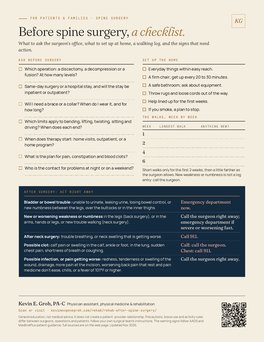
Free printable · PDF · 1 page
Before spine surgery: a checklist
The key questions, a home set-up list, a walking log for the first weeks, and the warning signs that need action, on one page to print and take to the surgeon's office.
Download the PDF 258 KBSources
- Debono B, Wainwright TW, Wang MY, et al. Consensus statement for perioperative care in lumbar spinal fusion: Enhanced Recovery After Surgery (ERAS®) Society recommendations. Spine Journal 2021;21(5):729–752. Retrieved via PubMed (PMID 33444664). Preoperative education and nutrition, multimodal pain control, and why prehabilitation was left out.
- American Academy of Orthopaedic Surgeons, OrthoInfo. Spinal Fusion. Light activity and walking after surgery, moving while the fusion heals, when physical therapy starts, braces, smoking and pseudarthrosis, and the warning signs of blood clots and infection.
- American Academy of Orthopaedic Surgeons, OrthoInfo. Herniated Disk in the Lower Back. Recovery after microdiscectomy, the walking program, limits on bending, lifting and twisting, and the chance of another herniation.
- American Academy of Orthopaedic Surgeons, OrthoInfo. Cauda Equina Syndrome. The symptoms, and why it is a surgical emergency.
- American Academy of Orthopaedic Surgeons, OrthoInfo. Cervical Spondylotic Myelopathy (Spinal Cord Compression). How pressure on the spinal cord in the neck shows up, including trouble walking and weakness in the legs.
- MedlinePlus Medical Encyclopedia (A.D.A.M.). Spine surgery – discharge. Reviewed June 4, 2025. Recovery after discectomy, laminectomy and fusion; bone healing and return to work; sitting, lifting, walking, stairs, driving and the brace; when to call the surgeon.
- Electronic Code of Federal Regulations. 42 CFR 412.29, Classification criteria for payment under the inpatient rehabilitation facility prospective payment system. The 60 percent compliance threshold and the list of conditions, paragraph (b)(2).
- Centers for Medicare & Medicaid Services. MLN Matters MM14098: Implementing the Transforming Episode Accountability Model: Skilled Nursing Facility 3-Day Rule Waiver. Latest revision September 29, 2025; effective January 1, 2026. The five episode categories, including spinal fusion, who qualifies for the waiver, and the skilled nursing facility star-rating requirement.
- Bazaz R, Lee MJ, Yoo JU. Incidence of dysphagia after anterior cervical spine surgery: a prospective study. Spine 2002;27(22):2453–2458. Retrieved via PubMed (PMID 12435974).
- Campbell MJ, Carreon LY, Traynelis V, Anderson PA. Use of cervical collar after single-level anterior cervical fusion with plate: is it necessary? Spine 2009;34(1):43–48. Retrieved via PubMed (PMID 19077924).
- Carragee EJ, Han MY, Yang B, Kim DH, Kraemer H, Billys J. Activity restrictions after posterior lumbar discectomy: a prospective study of outcomes in 152 cases with no postoperative restrictions. Spine 1999;24(22):2346–2351. Retrieved via PubMed (PMID 10586459).
- Cook C, Coronado RA, Bettger JP, Graham JE. The association of discharge destination with 30-day rehospitalization rates among older adults receiving lumbar spinal fusion surgery. Musculoskeletal Science and Practice 2018;34:77–82. Retrieved via PubMed (PMID 29358104).
- Feng AP, Yu SF, Zhu MT, He LR, Lin GX. Impact of postoperative bracing following spinal fusion for degenerative lumbar conditions: an updated meta-analysis of randomized controlled trials. International Journal of Spine Surgery 2024;18(5):540–550. Retrieved via PubMed (PMID 38744484).
- Glassman SD, Anagnost SC, Parker A, Burke D, Johnson JR, Dimar JR. The effect of cigarette smoking and smoking cessation on spinal fusion. Spine 2000;25(20):2608–2615. Retrieved via PubMed (PMID 11034645).
- Greenwood J, McGregor A, Jones F, Mullane J, Hurley M. Rehabilitation following lumbar fusion surgery: a systematic review and meta-analysis. Spine 2016;41(1):E28–E36. Retrieved via PubMed (PMID 26555833).
- Lim S, Bazydlo M, Macki M, et al. Validation of the benefits of ambulation within 8 hours of elective cervical and lumbar surgery: a Michigan Spine Surgery Improvement Collaborative study. Neurosurgery 2022;91(3):505–512. Retrieved via PubMed (PMID 35550477).
- McGregor AH, Probyn K, Cro S, et al. Rehabilitation following surgery for lumbar spinal stenosis. Cochrane Database of Systematic Reviews 2013;(12):CD009644. Retrieved via PubMed (PMID 24323844).
- Oosterhuis T, Costa LOP, Maher CG, de Vet HCW, van Tulder MW, Ostelo RWJG. Rehabilitation after lumbar disc surgery. Cochrane Database of Systematic Reviews 2014;(3):CD003007. Retrieved via PubMed (PMID 24627325).
- Overley SC, Merrill RK, Baird EO, et al. Is cervical bracing necessary after one- and two-level instrumented anterior cervical discectomy and fusion? A prospective randomized study. Global Spine Journal 2018;8(1):40–46. Retrieved via PubMed (PMID 29456914).
- Sagi HC, Beutler W, Carroll E, Connolly PJ. Airway complications associated with surgery on the anterior cervical spine. Spine 2002;27(9):949–953. Retrieved via PubMed (PMID 11979168).
- Tian Y, Li J, Zhou G, et al. Incidence, risk factors and airway management of postoperative haematoma following anterior cervical spine surgery: a retrospective nested case-control study. BMJ Open 2025;15(4):e090547. Retrieved via PubMed (PMID 40194872).
- Yee AJ, Yoo JU, Marsolais EB, et al. Use of a postoperative lumbar corset after lumbar spinal arthrodesis for degenerative conditions of the spine: a prospective randomized trial. Journal of Bone and Joint Surgery, American Volume 2008;90(10):2062–2068. Retrieved via PubMed (PMID 18829902).
- Zakaria HM, Bazydlo M, Schultz L, et al. Ambulation on postoperative day #0 is associated with decreased morbidity and adverse events after elective lumbar spine surgery: analysis from the Michigan Spine Surgery Improvement Collaborative (MSSIC). Neurosurgery 2020;87(2):320–328. Retrieved via PubMed (PMID 31832659).